
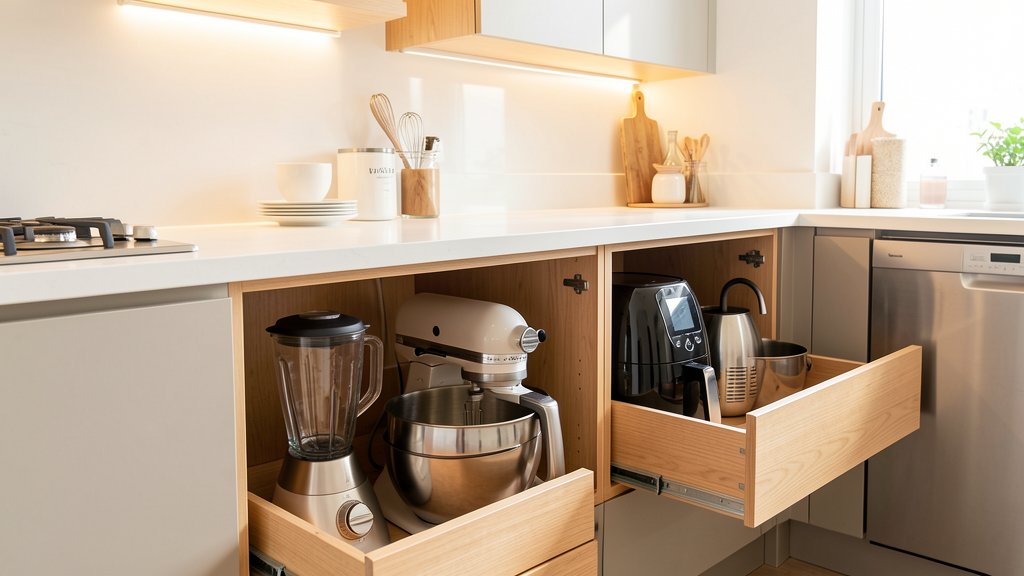


Your Pull-Out Shelves Are Sticking, Sagging, or Grinding — Here’s How to Tell Why (and Whether to Repair or Replace)
If a pull-out shelf in your kitchen has started to feel wrong — slow to open, heavy to pull, sagging on one side, or making a grinding sound — that’s not a small annoyance to live with. It’s a diagnosis waiting to be read. Hardware failure isn’t random: it follows patterns, and the pattern tells you exactly what’s failing, how badly, and whether you’re looking at a twenty-minute repair or a new shelf.
Here’s the honest part: most pull-out shelves in Phoenix homes were installed with budget hardware. The slides that shipped with them were designed for light-duty use — maybe twenty to forty pounds, partial extension, plain rollers or light ball bearings. They weren’t built to slide out fully under a hundred pounds of cast iron and canned goods, every day, for decades. So when they start acting up, it’s usually not your fault. It’s the hardware telling you it’s reached the end of what it was built for.
The Four Failure Modes — and What Each One Means
1. It Sticks or Grinds at One Point
Open and close the shelf slowly and find where the resistance starts. A single sticking point is almost always misalignment: the slide has shifted, the mounting screws have worked loose in the cabinet, or the cabinet itself has moved (Arizona humidity swings do this more than people expect). This is the easiest problem in the list — usually a few minutes of re-tightening and re-squaring. If the grinding persists after the screws are tight, the slide channel is worn and the slide should be swapped.
2. It’s Heavy or “Dead” to Pull
A shelf that used to glide but now takes effort to start moving has lost its rolling mechanism. In roller-based slides, the little wheels have flattened or jammed with kitchen dust and grease. In ball-bearing slides, the bearings have packed with debris. Light cleaning with a damp cloth and a touch of dry lubricant can recover a roller slide — but if the shelf is heavy on load, that’s a symptom of a roller system that was undersized for the job from the start.
3. It Sags — One Side Drops
Sagging is the most telling symptom in this list, and it points almost always to the load rating, not to wear. If a shelf sags when you load the back the way you actually use it, the slides were rated below what you’re putting on them. A shelf rated for twenty-five pounds carrying sixty will sag. This is the failure you can’t lubricate away. The fix is slides rated for the real load — 100 lb capacity, full extension, which is what we spec on every Shelf Theory install because it removes this failure mode from the equation.
4. It Bounces Back or Closes on Its Own
Soft-close mechanisms fail when the damper fluid leaks or the hinge-style pivot wears. This is the most annoying failure and the least dangerous — but it’s also the hardest to repair on older units, because the soft-close is integrated into the slide and usually can’t be serviced in place. Swapping the slide set is typically faster than chasing the damper.
When Repair Makes Sense — and When It Doesn’t
Here’s the practical rule we give customers: cheap hardware is cheap to replace, so replacing it is usually the move. A set of quality 100 lb full-extension ball-bearing slides costs a fraction of a new custom shelf, and the installation is straightforward — measure, unmount the old slides, mount the new ones, re-hang the shelf. If your shelf is a solid-wood custom build with good joinery, keep the shelf and upgrade the slides.
The answer flips when the shelf itself is the problem: cheap particleboard that’s swollen at the slide mounts, a warped shelf board, or a drawer front that’s started to bow. Repairing the slides on a failing shelf board is paying twice. That’s when the right move is a new pull-out, built to your cabinet’s exact dimensions with hardware that won’t develop this failure pattern in the first place.
We go into more detail on how to read the care and maintenance of slides that are working well in our pull-out shelf slide care guide, and the deeper dive on what separates commercial-grade hardware from the rest is in what makes a quality pull-out shelf.
The Phoenix Angle: Why It Happens Faster Here
Two local factors accelerate hardware wear in the Valley. First, fine dust — from the desert, from cooking, from the open-concept floor plan — works into slide channels faster than in most climates, and it’s abrasive. Second, temperature swings between a 110-degree summer and a heated winter shift wood and metal at different rates, which puts constant low-grade stress on mounting screws and alignment. Neither is dramatic on its own; together, they’re why a shelf that glides in Seattle will start sticking in Scottsdale sooner. Both are also why the hardware rating matters more here than the brochure suggests.
Get a Second Opinion Before You Replace
If one of the four symptoms above sounds familiar, the shelf might be fine and just need better hardware — or the shelf might be the thing to replace. Either way, the fastest way to know is to have a professional look at it. Call Shelf Theory at (602) 799-9626 or request a free in-home design consultation. We’ll tell you honestly whether your current shelf is worth saving, what the hardware failure actually is, and exactly what a proper fix costs before you spend a dollar on it.