
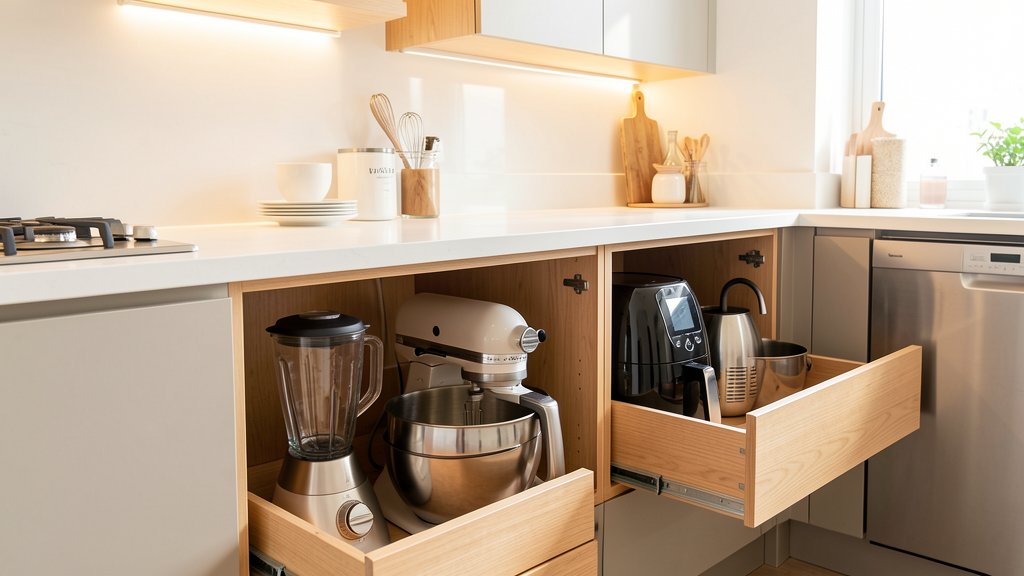


Open the base cabinet next to your range and try this: reach the back with one hand. If your fingers meet a wall of dark space before they find anything useful, you have a deep cabinet problem. It’s not a defect. It’s just how most kitchens were built, and it’s the single biggest reason kitchens feel like they never have enough storage even when the cabinets are full.
Why Deep Cabinets Are So Hard to Live With
Base cabinets in most Phoenix homes are built 14 to 24 inches deep. That depth makes sense for the cabinet box — it matches the countertop. But nothing about that depth was designed around your body. The front of the box is comfortable. The back of the box is a vault: everything in it requires a full extension, a kneeling position, or both. And the physics get worse over time, because the heaviest items — the pots, the cast iron, the full-size serving dishes — are the ones that end up at the back, where they’re hardest to reach.
That’s where the vault problem compounds: the heavier the item, the deeper it sits, the harder it is to get out. A can of soup in the back is annoying. A Dutch oven in the back is a back problem.
The Five Ways Deep Cabinets Get Fixed
1. The full pull-out (the real fix)
A custom pull-out shelf replaces the fixed shelf with a drawer that slides out on full-extension ball-bearing hardware. The back of the cabinet becomes the front. Everything is at your hand, loaded or not, and the whole assembly is rated for real weight. It’s the most expensive option on this list, and it’s the only one that changes how the cabinet works instead of how you use it. If the cabinet gets daily use, this is the one. We cover the details on our pull-out shelves page and the kitchen version on kitchen pull-out shelves.
2. A half pull-out
Half the width of the cabinet slides out on two slides; the back half stays fixed. Cheaper than a full pull-out, and it works when one side of the cabinet is deep enough to need help but the other side holds something light and flat. The tradeoff: you still reach past the fixed half for the deep stuff. It’s a middle step, not an end point.
3. Adjustable shelving, done right
If the cabinet has a fixed shelf, removing it and splitting the box into two shorter levels is free and it helps — but only up to a point. The back of the cabinet is still the back of the cabinet. This works best when the cabinet already sits at a height you can reach, and the contents are light. It’s the right answer for the cabinet where the problem is one shelf that’s too high, not depth.
4. A lazy Susan
The rotation solves reach in a circle, not in a box. For a deep base cabinet with heavy items, it’s the wrong tool. For a shallow drawer of spices, it’s fine. We write the full comparison in our lazy Susan vs pull-out post, but the short version: if you’re kneeling, the carousel isn’t the fix.
5. Toe-kick trays
The four inches of dead space at the bottom of the base cabinet row takes a slim pull-out tray. It won’t hold the pots, but it reclaims real space for baking sheets, the rolling pin, and the things you open the cabinet to find and then forget for a year. Cheap, quick, and it pairs well with a full pull-out above it.
Which Cabinet Gets the Expensive Fix?
Not all of them. Here’s the test we use:
- Daily reach, heavy contents — the cabinet next to the range, the cabinet under the sink (for the daily stuff), the pantry row. These take the full pull-out. The frequency of use pays for the hardware.
- Daily reach, light contents — spice and small-item drawers. Adjustable shelving or a lazy Susan can do it. Don’t overspend.
- Monthly reach — holiday serving pieces, the good tableware. A half pull-out or good shelving is plenty.
- Rarely touched — the back of the pantry, the top of the tall cabinet. Leave it. Fixing a cabinet you use twice a year is the first budget line to cut.
The Part People Miss: Measure Before You Buy
Deep cabinet boxes are not standard. A cabinet built in 1998 and one built in 2018 will both say “base cabinet” on the box, but the interior width, the door gap, the clearance under the countertop — they’re all different. A pull-out that’s a quarter-inch too wide won’t close. A shelf that’s built for a 24-inch box and dropped into a 23-inch box looks fine until the door stops swinging. The reason custom work exists is that this measurement step is where the whole project lives or dies. That’s also why we measure every cabinet ourselves on the consultation visit and build to that measurement — no shims, no “close enough.”
When a Deep Cabinet Shouldn’t Be Fixed
Honesty corner: if the cabinet box itself is warped, soft, or full of water stains, the slides will only make the problem worse. The fix for a bad box is not better hardware; it’s replacing the box, and that’s a cabinet-replacement conversation, not a pull-out conversation. If your cabinets are structurally fine and just arranged the wrong way, the pull-out is the answer. If the boxes are tired, no hardware upgrade will save them.
Start With One Cabinet
The cheapest test of whether this is worth it for your kitchen: pick the single cabinet you reach most often, and fix just that one. If it’s the range-adjacent base, it’s probably a full pull-out. If it’s the spice drawer, it’s probably shelving. One cabinet, done right, tells you more than any checklist. Then decide the rest with actual data.
Every shelf we build is made to order in Phoenix, measured to your cabinet, installed in a single visit, and backed by a lifetime warranty. If the back of your cabinets has become a storage problem, schedule a free in-home consultation and we’ll walk the boxes with you. Call (602) 799-9626 and we’ll take a look together, free.