


The Most Expensive Storage Upgrade in Your Home
You spent money on the walk-in closet. The hardware was decent, the lighting is fine, and the rods hold the coats and the hanging dresses. But if you walk into it for two minutes and can’t find the one shirt you were about to wear, the system isn’t working.
Walk-in closets are the biggest storage rooms in most homes, and they’re the first ones to turn into junk. Shelves get buried. The rods get crammed until nothing slides anymore. The floor is a graveyard of shoes. And the one thing you actually need is at the very back of the shelf, behind six other things.
Here’s what nobody tells you about closet organization: the biggest upgrade isn’t adding more shelving. It’s converting the shelves that already exist into pull-out systems so the back of the closet stops being a black hole.
Why a Walk-In Closet Is the Hardest Space to Keep Organized
A closet is built for a specific load: hanging clothes on rods and folded things on two or three static shelves. You’ve built a life around a lot more than that. Shoes. Bags. Luggage. Off-season clothes. The box of things you’ll never wear but won’t throw away. The gym gear. The dog’s leash.
Four problems make a walk-in closet fail faster than any other room:
- Depth. Standard closet shelves are 24 inches deep. The back third of that shelf is where the stuff you don’t use goes — because you can’t see it, you don’t think about it, and it accumulates.
- Vertical sprawl. The top shelves hold what you need once a year. The bottom holds the heavy stuff. The middle is where the stuff you use daily competes for space with the stuff you used three months ago.
- No gravity assist. A kitchen drawer or pull-out shelf slides out on rails. A static closet shelf requires you to stand, reach, and dig. The friction is enough that most people just stop putting things back.
- No dedicated zone for the things that don’t hang. Shoes, bags, and accessories have nowhere to live that isn’t the floor or the top shelf. So they pile up in the one place where they’re visible and annoying.
The pattern is predictable: the closet looks fine for a few months, then slowly degrades until you either live with the chaos or you spend a weekend reorganizing it and the whole thing resets within two weeks.
The Pull-Out Shelves That Actually Change a Walk-In Closet
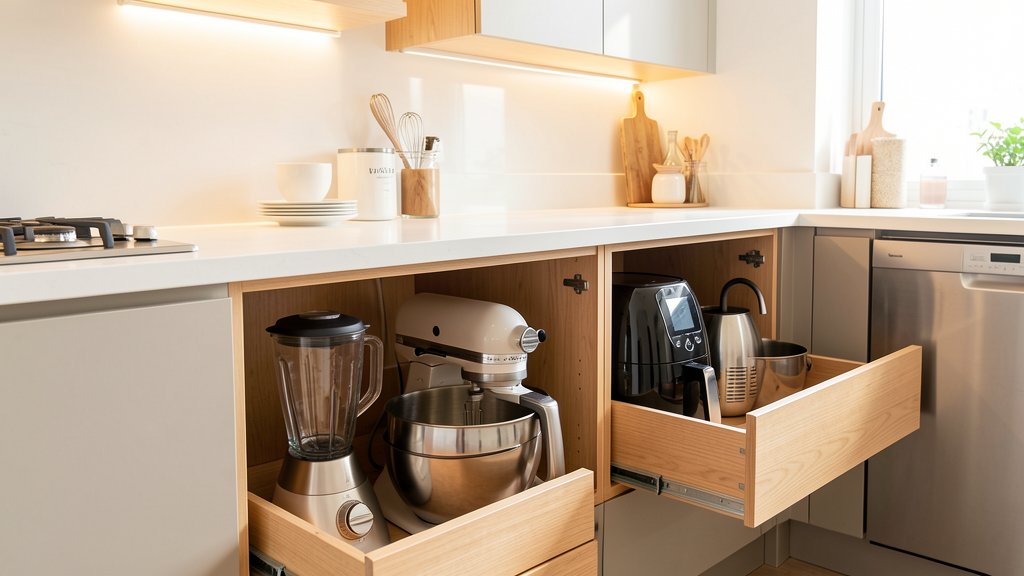
A pull-out shelf in a closet works the same way as it does in a kitchen: the entire shelf rides on full-extension ball-bearing slides, comes all the way out, and stops. You don’t reach past the front items. The shelf does the reaching for you.
In a walk-in closet, the highest-impact conversion is the shelf-to-shelf system:
- The shelf that holds your folded clothes. This is the one that fails fastest. A static shelf buried under sweaters and t-shirts becomes unreachable. Convert it to a full-extension pull-out and the back third of the shelf is just as accessible as the front.
- The shelf above the hanging rods. This is where the “we’ll deal with this later” boxes live. A slim pull-out up top gives you a reachable, organized layer for the things you grab a few times a season — scarves, hats, the holiday decorations, the luggage that always seems to need to be at arm’s reach when travel time hits.
- The bottom shelf or base area. This is where the heavy stuff goes: boots, the tool box, the boxes you swore you’d sort. A sturdy, wide pull-out rated for the load keeps the floor clear and the bottom of the closet functional instead of a storage graveyard.
Because we build each shelf to the exact width and depth of your cabinet, nothing bangs against the door when it slides out, and the slides carry the full weight instead of the shelf brackets. On a closet where the shelves are 24 inches deep, a full-extension pull-out gives you access to every inch of that depth — not just the first six.
The Phoenix Angle: Heat, Dust, and the Stuff You Actually Own
Phoenix homes hold more stuff than most American homes, for three reasons:
- The climate punishes storage. In the summer you need the water bottles, the sunscreen, the shade cloth, and the bug spray accessible. In winter you need the heavier clothes out of rotation. A closet that can’t slide means you’re digging for the one thing you need in the heat.
- Dust. The red dirt and the desert dust get into everything. A static shelf buried at the back of a closet is a dust trap. A pull-out that slides out on smooth slides lets you see what’s back there and wipe it down instead of just pushing new stuff in front of it.
- Resale. Buyers walk into the master bedroom and see the closet first. A walk-in that has organized, smooth-gliding storage reads as a move-in-ready home in the same way a clean kitchen does. It’s a small install relative to the impression it makes on a $700,000 home.
The second reason Phoenix homeowners invest in closet pull-outs: the resale value argument. A well-organized walk-in closet is one of the features that shows up in the listing description and gets mentioned by the agent. It’s not the most expensive upgrade, but it’s the one that photographs the best.
What It Costs and What It Looks Like
A typical walk-in closet conversion — two or three shelves converted to full-extension pull-outs, measured, built in hardwood, and installed — lands in a similar range to a small kitchen project. Most homeowners are looking at a few hundred dollars up to around $1,000 depending on how many shelves you’re converting and how much heavy load you need to move.
The timeline is short. A free in-home consultation and measurement takes about 30 minutes. We build to your exact measurements and most installs are finished in a single visit. No changes to your cabinet boxes, doors, or the hanging rods. No mess left behind.
For a full breakdown of the hardware that holds up under real daily use, see our guide to what makes a quality pull-out shelf. And a full tour of what we build across every room lives at our pull-out shelves page.
Stop Reorganizing the Same Closet
If your walk-in closet looks fine on the surface but takes you two minutes to find anything, the problem isn’t your organization habit. The problem is that the shelves don’t slide.
Call Shelf Theory at (602) 799-9626 or request a free in-home consultation. We’ll measure the shelves, show you exactly what a pull-out system would look like in that exact space, and give you a written quote before anything gets built.
Your closet doesn’t need more shelving. It needs the shelves it already has to actually work.