


Ask any two-pet household where the dog food lives and you’ll get the same answer: under the sink, in a cabinet you have to crouch into, on a shelf where a spilled crumb ends up under the faucet. It’s not a storage choice — it’s a storage default. Pet food is heavy, it’s messy, and the only cabinet that’s “big enough” is usually the one with the plumbing.
The good news: there’s a better default, and it takes one cabinet. Here’s how pet food storage actually works when it’s designed instead of dumped.
Why the sink cabinet wins every time
It’s not an accident that pet food ends up under the sink. The sink cabinet is usually the deepest, widest base cabinet in the kitchen — the only one a 30 lb bag physically fits in. And it’s low, so it feels like the natural floor level for “stuff that weighs something.”
The problems are:
- Moisture. Kibble left loose or in an open bag near plumbing is one slow leak away from a soggy, unusable bag. In a Phoenix summer kitchen, that’s weeks, not months.
- The bend. Crouching into a sink cabinet two or three times a day, every day, adds up — and it’s the exact motion aging-in-place planning tries to eliminate.
- The mess. Open bags and scattered kibble in a cabinet where crumbs have nowhere to go.
The fix: a dedicated base-cabinet pull-out
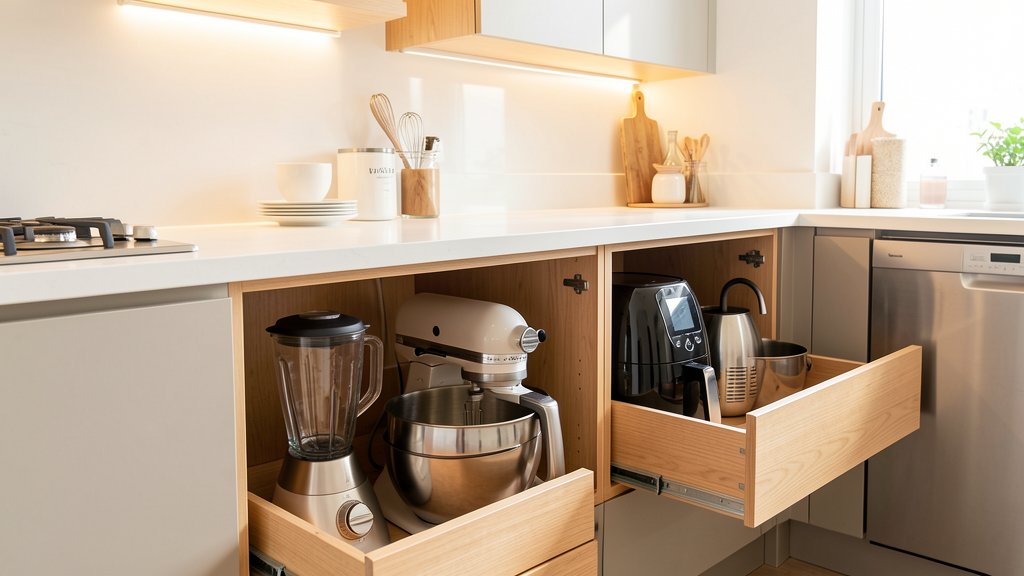
Instead of a stock shelf, the sink cabinet gets a custom pull-out tray system sized to the cabinet and built around the plumbing. The setup that works best in practice:
- Lower tier, heavy items: the unopened and open bags live here. A 100 lb rated full-extension slide handles a 30 lb bag with room to spare, and the whole tray rolls out level — no tilting, no dumping.
- Upper tier or adjacent narrow pull-out, daily-use items: the kibble scoop, the sealed container, the treat bags. Out at arm’s reach, no bending.
- Crumb control: the tray’s edge keeps spilled kibble inside the cabinet. It comes out with the tray instead of staying on a shelf you’ll have to reach in and sweep.
And because it’s a pull-out, the whole storage system comes out to you — which is the entire point. You load and unload while standing, the way a pantry should work.
Sizing it for your bags (and your cabinets)
A 30 lb bag of dry food sits roughly 18 by 24 inches. Most standard base cabinets fit one flat with a custom tray — but “standard” is doing a lot of work in that sentence.
If your home was built before the 1990s, or in many Valley subdivisions, the cabinet is almost certainly not standard: odd widths, short depths, a plumbing stub in the corner. That’s the whole reason this is a custom job. We measure the exact width and depth of your cabinet, design the tray to clear the plumbing, and build it to fit — no shimmed, forced, or “close enough” hardware. If you’re curious what that means in practice, our breakdown of older Phoenix homes and the cabinets that were never measured twice walks through the patterns we see most.
One more sizing tip: if you run a bulk-bag setup (the 40+ lb variety), check the cabinet depth before you fall in love with the price. A pull-out that can’t fully extend behind a deep bag solves half the problem.
Keeping kibble fresh in a Phoenix kitchen
Weight and access are half the job. Freshness is the other half, and it’s a storage-design problem more than a pet-supply problem:
- Sealed container on the accessible tier. The daily kibble lives in an airtight container in the part of the system you reach most. The big bag stays behind it as the reserve.
- Keep it off the floor of the cabinet. A tray at the slide’s level puts the food above any slow plumbing drip — the exact failure that ruins sink-cabinet storage.
- Heat and rotation. Arizona kitchens run 80°+ in summer. Rotate the reserve bag and you’ll notice the difference in the kibble — smell aside, it kinks and goes stale faster in the heat when it’s just sitting there for months.
The drawer you’ll forget you have
While we’re measuring and building, there’s a bonus worth taking: the narrow pull-out next to the pet food bay. It becomes the catch-all for the pet stuff that never has a home — treats, vitamins, preventatives, the syringe drawer, the backup can opener for the wet food. One narrow pull-out with dividers turns a pile of drawer detritus into something you can actually find in the dark at 6 a.m. When it’s all in one rolling drawer, you stop storing “pet stuff” in six places, and it shows up at the vet, in the car, and on the kitchen floor.
Start with the free measurement
Whether it’s the sink cabinet, a spare base cabinet, or a narrow pull-out you didn’t know you could get — it starts the same way. A free in-home consultation across the Phoenix metro: we measure the cabinet, walk through how your dogs or cats actually use the food, and you get a real quote for the exact system that fits.
Call (602) 799-9626 or request your free consultation online. Your cabinets can hold the weight — the question is whether the hardware underneath was rated for it. Our guide to which cabinets to upgrade first will tell you where to point that hardware.