


The One Cabinet Everyone Forgets
Your kitchen got the pull-out shelf upgrade. Your pantry is dialed in. Your bathroom finally makes sense. But walk through your front door after a trip to the hardware store and you still get the same feeling: the mudroom is a junk drawer with a roof.
Coats draped over a hook. A stack of boxes you meant to organize three winters ago. Shoes scattered across the tile. The recycling bin doing the thing where it slowly tips over. And somewhere at the bottom of that long skinny cabinet, a first-aid kit you will genuinely need someday.
The mudroom is the hardest storage space in the house because everything in it is temporary. Stuff flows in, nothing flows out, and the one place it all lands is a cabinet built before you ever decided to live in it.
The fix most Phoenix homeowners never consider: the mudroom cabinet is a perfect spot for custom pull-out shelves.
Why Mudrooms Fail (It’s Not Your Organization Habit)
Here’s the thing about a standard mudroom cabinet: it’s built for a coat and a hat. You built your life around groceries from two stores, a family that brings home muddy boots, a recycling commitment, a tool box, and a mountain of “we’ll deal with this later” boxes. The cabinet did not update itself.
Three things make a mudroom cabinet worse than it looks:
- Deep, narrow boxes. Most mudroom cabinets are built to match a door frame, which means they’re deep and not wide. Standard shelving forces you to reach past everything in front.
- Low and high dead zones. The bottom shelf collects what nobody wants to bend over for. The top shelf holds what nobody wants to climb a step stool for. The middle is for the stuff you actually use, which is exactly what’s buried.
- Weight. Shoes, bins, bottles of cleaner, and the tool box are heavy. Wobbly shelves with cheap rails sag under that load and stop sliding.
When the contents of a cabinet can’t reach you, you stop putting things away. That’s not a discipline problem. That’s a cabinet problem.
What a Custom Mudroom Pull-Out Actually Looks Like
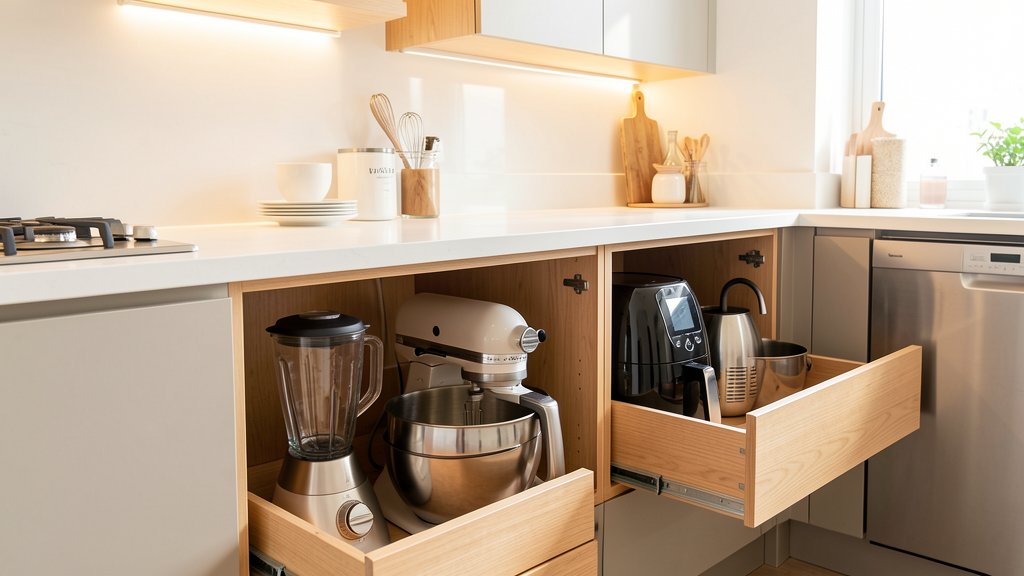
A pull-out shelf converts that dead cabinet into a sliding system that comes all the way out to you. Instead of reaching in past the boxes, the whole layer slides onto full-extension ball-bearing slides and stops with your hands free.
A typical mudroom setup runs in tiers:
- Top tier: a slim pull-out for the stuff you grab weekly — sunscreen, dog leashes, mail organizers, the kids’ activity folders.
- Mid tier: a sturdy full-width pull-out rated for 100 lb per slide, sized for bins, shoe storage, and cleaning supplies that actually get used.
- Bottom tier: a deeper pull-out for the heavy and the rarely used — the tool box, the recycling that overflows, the box of hardware you swore you’d donate.
Because each shelf is measured to your cabinet’s exact width and depth, nothing shims, nothing bangs against the door, and the slide hardware carries the real load instead of your shelf brackets. On a narrow cabinet, we spec the slides to full extension so the far back of the shelf is as accessible as the front.
And because these are hardwood shelves built for daily abuse and Arizona dust, a mudroom pull-out survives the exact abuse a kitchen shelf doesn’t get: wet shoes, muddy backpacks, and the occasional bottle of cleaner that leaks.
The Phoenix-Specific Reason This Matters
Phoenix homes are built for a climate that punishes storage. In summer, the mudroom is where the water bottles, the sunscreen, the bug spray, and the shade cloth all pile up before you head out. In monsoon season it’s where the wet boots and the towel for the door land. When the cabinet doesn’t slide, that traffic makes a mess of everything else in the house.
The second reason: resale. Buyers don’t care about your cabinets much, but they notice the mudroom in the first ten seconds of a showing. A mudroom with organized, smooth-gliding storage reads as a move-in-ready home. It’s a small install relative to the impression it makes.
What It Costs and How Long It Takes
A typical two-or-three-tier mudroom system — measured, built, and installed — lands in the same range as a small kitchen project: most homeowners are looking at a few hundred dollars up to around $1,000 depending on cabinet dimensions and how much heavy load you need to move.
The timeline is short. A free in-home consultation and measurement takes about 30 minutes. We build to your exact measurements and most installs are finished in a single visit, with no changes to your cabinet doors or boxes and no mess left behind.
You can see how the hardware and the build hold up in our breakdown of what makes a quality pull-out shelf, and a full tour of what we build across every cabinet type lives at our pull-out shelves page.
Start With the Cabinet That’s Losing
If your mudroom has a cabinet that feels like a dumping ground, it’s not a habit to fix — it’s a hardware problem. The cabinet can work as hard as the kitchen, with the same smooth full-extension slides and the same hardwood build.
Call Shelf Theory at (602) 799-9626 or request a free in-home consultation. We’ll measure the cabinet, show you exactly what a pull-out system would look like in that exact space, and give you a written quote before anything gets built.
Your front door doesn’t need to be the messiest room in the house. It just needs the cabinet to work.