
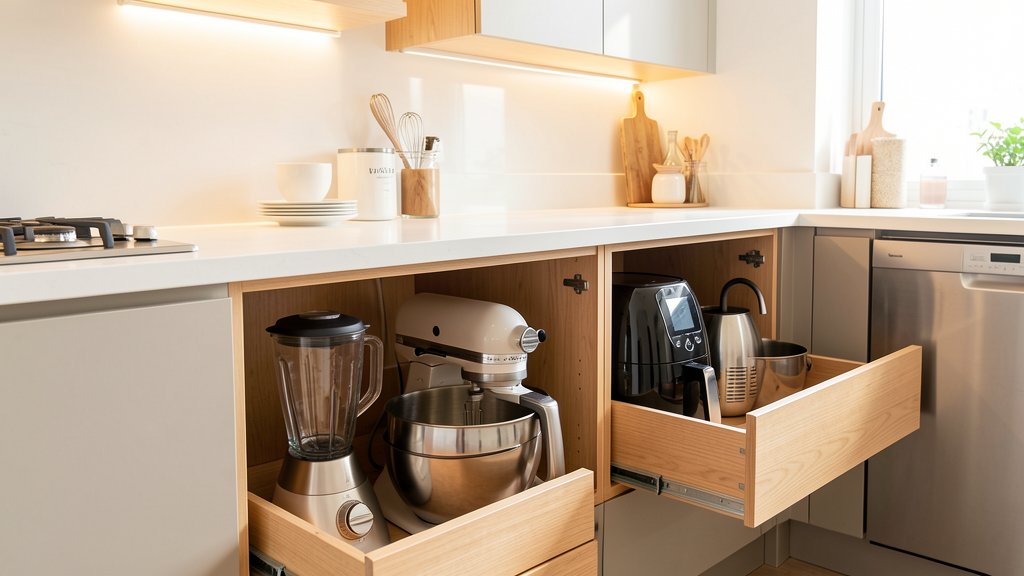


What Happens Between “Measurements Done” and “Shelves Installed”
You book a free consultation. We measure your cabinets. Two weeks later, shelves that fit your kitchen like they grew there are on the floor. In between those two moments, a lot happens in our shop — and most of it you’ll never see. So let’s show you.
Knowing how your pull-out shelves are made is one of the best ways to understand why they feel so different from anything you’ve bought at a store.
Step One: Measuring Is More Than Measuring
The free in-home consultation is where the real work starts. We don’t just tape the interior width of each cabinet. We record the depth to the back panel, the exact door swing and how it clears when open, the drawer boxes that share space with the cabinet, the toe-kick height, and anything else that would interfere — a pipe, a gas line, a shelf pin from the old life of that cabinet.
Every number from that visit becomes part of a spec sheet. That’s why installations in Phoenix homes — where cabinets were often built to nobody’s spec book in the first place — still fit the first time. If a measurement is off by a sixteenth of an inch, the shelf doesn’t just “almost fit.” It doesn’t fit.
Step Two: Materials Matter More Than Finish
In our shop, the first cut is quality control, not aesthetics. We build on hardwood and quality lumber that can take a load and years of Arizona dry heat without warping — the finish just makes it look good in between. The finish matters for spills and daily use, but the board selection is what keeps a shelf flat and square a decade from now.
Then there’s the hardware, and this is where most pull-outs — custom or store-bought — eventually fail. Most cheap slides are rated for 50–70 lbs and wear out under the weight of a full pantry. Ours are 100 lb capacity, full-extension, ball-bearing slides. Full extension means the shelf comes all the way out so the back of the cabinet is usable; ball bearings mean it stays smooth and quiet instead of dragging. A shelf built on bad hardware is a shelf you’ll be replacing in five years. That trade-off is usually invisible at install time — which is exactly why we talk about it in every quote.
Step Three: The Shop Visit, Piece by Piece
Each shelf is cut to its cabinet’s spec, built, fitted, and slide-tested before it leaves the shop. We run the slides under load. We check squareness. We check that the shelf rides smooth from fully closed to fully extended, with no catch and no rattle. A shelf that’s perfect at 90% open but drags at full extension doesn’t ship.
This is also where we match finishes to your kitchen. Oiled, stained, or clear — it’s your call, and it’s something you only get to decide on a custom build.
Step Four: Installation Is Usually One Visit
Install day is the part people find pleasant. Most projects finish in a single visit: the cabinet gets prepped, the slides mount to the box, the shelf drops in, and you test it yourself before we leave. No demolition, no dust sheets covering the living room, no changes to your cabinet boxes, doors, or faces. Your cabinets stay exactly what they are — they just work.
Because everything was measured in advance and built to those numbers, install day doesn’t involve surprises. We don’t show up to discover a gap we didn’t account for, and you don’t wait for follow-up visits to fix fit issues.
Why We Do It This Way
There’s a reason we don’t sell pre-built units and drive around Phoenix handing them out: the gap between “a cabinet” and “your cabinet” is where all the value lives. Standard products can’t close it. That’s also why we can stand behind every shelf with a lifetime warranty — we know exactly what it’s made of, how it was built, and how it will hold up. The exclusions are the ones you’d expect: fire, flood, moisture damage, and misuse. Normal kitchen life is what it’s covered for.
Want to see how this works on real projects? Our pull-out shelves page walks through the kinds of cabinets we handle, from kitchen base cabinets to pantry systems and specialty pull-outs.
See What Your Kitchen Could Do
The whole process starts with a free in-home design consultation: we look at your cabinets, measure everything, and give you a clear written quote before any work starts. Most homeowners are surprised how much usable space is hiding in cabinets they’ve given up on.
Schedule your free consultation, or call (602) 799-9626 and we’ll get you on the calendar.