


The 2026 kitchen trend taking over Phoenix and Las Vegas
Walk through any kitchen remodel gallery in 2026 and you’ll see it everywhere: floor-to-ceiling cabinets. No gap at the top. No little strip of wall hiding dust and a forgotten Tupperware lid. The look is clean, it feels like a showroom, and it makes small kitchens feel bigger. Designers keep calling it one of the biggest shifts in kitchen organization this year, and homeowners from Phoenix to Las Vegas are noticing fast.
But here’s the part the trend photos never show you: what happens when those tall, top-heavy cabinets are actually lived in. A beautiful floor-to-ceiling cabinet run that you can’t reach or see inside is just a very expensive storage closet. The good news is that the fix is straightforward, and it’s the same principle we build into custom pull-out shelves every day.
The problem with "up top" storage
Most upper cabinets in homes built before the last decade were designed around a simple rule: if you can’t reach it, don’t store it up there. In practice, that means the top shelf of your upper cabinets became a graveyard for the things you use maybe twice a year — or a shelf you simply stopped using at all.
Then floor-to-ceiling designs added a new problem. To get that sleek top-out look, builders added a second cabinet tier up higher still. Now you’ve got three tiers of upper storage, and the top two are reachable only with a step stool, a wobble, or a prayer.
Meanwhile the same kitchen sits on the counter, on the floor, and in the pantry overflowing — because the upper space that should be holding things is functionally locked. That’s the irony of the trend: it adds all this storage and removes all the access.
Why floor-to-ceiling works — when it’s built right
The difference between a floor-to-ceiling cabinet that works and one that frustrates isn’t the cabinets themselves. It’s the storage inside them. Here’s what separates the two.
Pull-out upper shelves are the fix
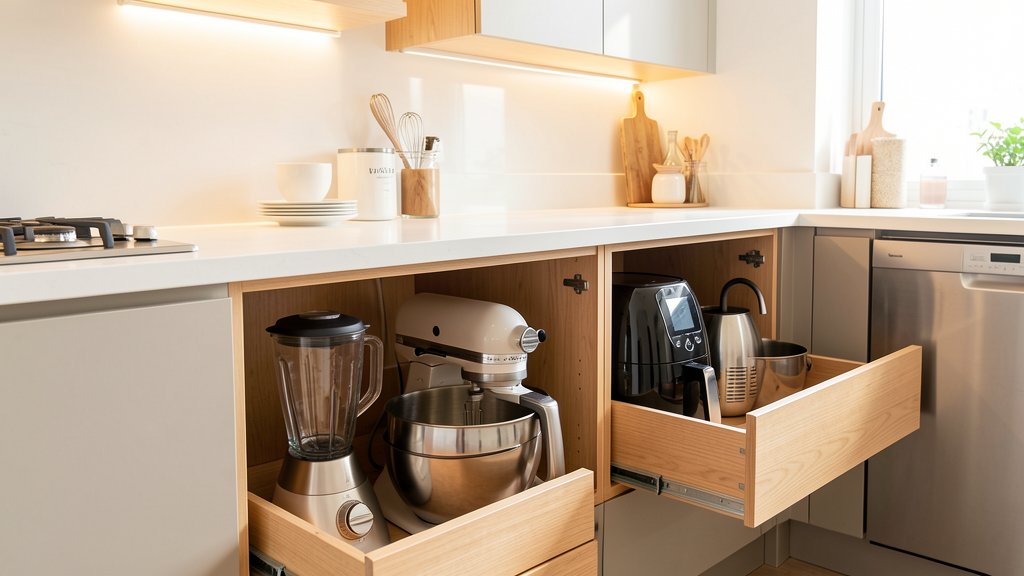
The single biggest upgrade you can make to a tall cabinet run is converting the upper tiers to pull-out shelves. Instead of bending up and squinting into a dark box, the whole shelf slides toward you on full-extension ball-bearing slides — the same 100-lb capacity hardware we standardize on our custom pull-out shelves. The top tier comes to your chest height. You see everything, reach everything, and put things back with zero wobble.
This is the reason pull-out systems are now standard in the better 2026 remodels: without them, a floor-to-ceiling cabinet is a storage liability, not an asset.
Tiered storage beats one deep shelf
On pull-out uppers, use two shallow tiers instead of one deep one. The front tier holds what you use daily — the mugs, the everyday plates, the glassware. The rear tier holds the occasional items: the holiday platters, the backup serving dishes, the baking sheet you use four times a year. Shallow tiers mean nothing hides behind anything, and the whole shelf stays usable instead of becoming a back-row junk drawer.
Match depth to the zone
Not every upper cabinet deserves the same treatment. Above the range, pull-outs are a safety no — heat, grease, and fire codes all say keep that one fixed. Above the sink and at the work zones, pull-outs earn their keep. And the glassware and stemware up top? That’s the tier where tiered pull-outs plus a few dividers make the whole kitchen feel like a restaurant back-of-house.
The benefits (beyond the pretty photos)
Once the uppers actually work, the whole kitchen changes:
- More real storage, not just more space. You finally use the cubic feet you already paid for — in Phoenix and Las Vegas, where kitchens often run on the smaller side, that’s a lot of square footage recovered.
- Cleaner counters. When uppers are reachable, dishes stop migrating to the counter to live there permanently.
- Less heat in the worst place. Storing heavy everyday items at head height instead of on a lower fixed shelf keeps the kitchen visually lighter and the work zones clear.
- It holds up in a hot climate. Tight-fitting upper cabinet doors that seal well keep out the Phoenix and Arizona dust that settles on every open top shelf by the end of summer.
- Resale appeal. A kitchen where every cabinet actually works is easy to point at and sell — “the uppers are all pull-out” is a line buyers remember.
Doing it right here in the Valley and beyond
Local buildings make this trend even more worthwhile in our area. A lot of West Valley and Phoenix kitchens have high ceilings that beg for the top-out look, but the heat and dust that come with Arizona summers punish any upper storage that’s open or loosely fitted. And if you’re out in Las Vegas, the same logic applies — the dry desert air means open shelves collect dust twice as fast as anywhere else.
The sequence that works: plan your kitchen organization zones first, then size the custom pull-out shelves for each upper cabinet around what actually lives there, then let the containers and dividers do the fine detail. Do pantry organization and the base cabinet pulls the same way, and the whole kitchen ends up as one system instead of a collection of boxes.
That’s the 2026 version of the trend — floor-to-ceiling on the outside, pull-out everything on the inside. The photos sell the look. The hardware makes it liveable.
Ready to make your uppers work as hard as your counters?
The floor-to-ceiling trend isn’t going anywhere in 2026 — it’s the direction new kitchens are heading across the country. The question is only whether the storage inside will keep up with the look outside.
Contact Shelf Theory today for a free consultation, and we’ll walk your kitchen, map the upper cabinet storage zones, and show you exactly which cabinets should get custom pull-out shelves so every inch you added actually works for you.