


The $30 Organizer That Vanishes From Your Kitchen in Two Years
You know the scene. You’re in the storage-aisle of a big-box store, holding a $29.99 plastic drawer organizer that promises to “transform your kitchen.” You buy three of them. Two weeks later, one has already been shoved to the back of a cabinet because it didn’t quite fit, and the other two are doing the quiet work of holding a bunch of stuff at eye level while the real mess sits behind them.
If that sounds familiar, the problem isn’t your kitchen. It’s the product.
Store-bought organizers are manufactured to fit a cabinet that exists on paper: standard widths, standard wall thickness, standard doors, standard everything. Real kitchens don’t work that way. A cabinet that’s a quarter-inch narrower than spec won’t take a shelf that’s spec-sized. A door that swings the wrong way blocks an organizer you just spent an hour mounting. And plastic — no matter how sleek it looks in the packaging — flexes under the weight of cast iron, stand mixers, and a shelf’s worth of canned goods.
What “One Size Fits All” Actually Fits
Even inside a single kitchen, cabinet boxes aren’t uniform. A remodeled section was built with different lumber and different tolerances than the original cabinetry. Toe-kicks vary. Drawer boxes take up space. Back panels are sometimes half-inch, sometimes three-quarter. A pantry cabinet in a 1990s Valley home and the same cabinet in a 2020 build can differ by inches, and off-the-shelf products can only hedge in one direction.
That’s why the failure mode of store-bought organizers is never “this doesn’t work at all.” It’s “this almost works.” And “almost” is where kitchens go to rot: the shelf that’s a little short, the tray that drags, the spice rack that fits the cabinet but not the spices you actually own.
What Custom Actually Means
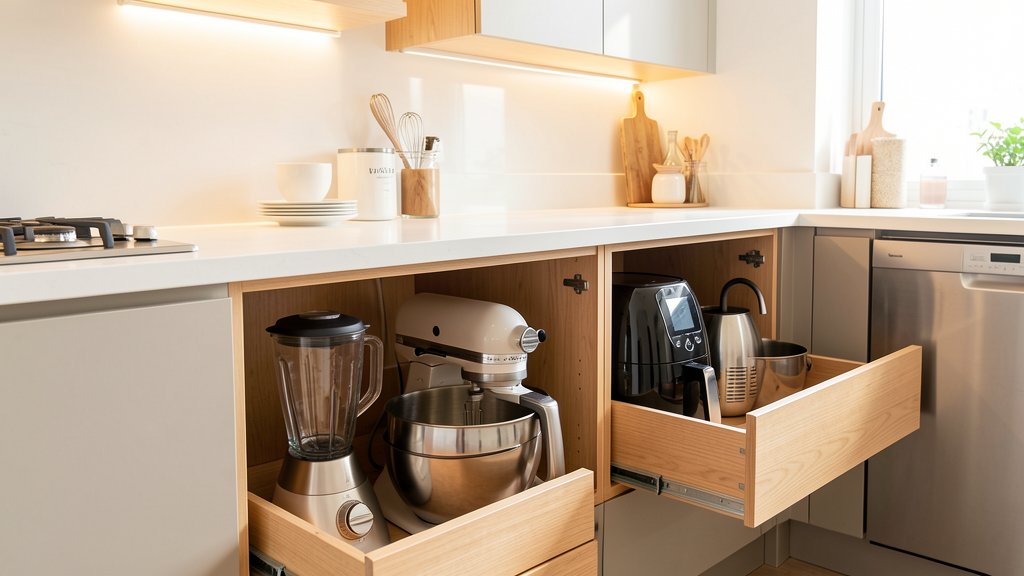
Custom pull-out shelves start with your cabinet, not a product catalog. A custom maker comes to your house, measures the exact width, depth, and interior clearance of each cabinet, and notes the door swing, the drawer boxes, and anything else that would get in the way. The shelf that comes back off the shop floor is built to those numbers — hardwood sides, a finish that holds up in an Arizona kitchen, and 100 lb capacity, full-extension, ball-bearing slides that carry the shelf all the way out and stay smooth under a full load.
Custom also solves the problems off-the-shelf can’t touch: blind corner cabinets, under-sink spaces around plumbing, narrow pull-outs for spices and oils, deep base cabinets for pots and small appliances. If a cabinet is odd, that’s not a disqualifier — it’s the whole point.
The Real Cost Comparison
Here’s the math that surprises people. Store-bought organizers run $30 to $80 per cabinet, and most owners replace at least a couple of them within a few years because they sag, crack, or stop fitting. A typical custom project — ten pull-out shelves, built to fit and professionally installed — starts around $999. Per cabinet, custom is often in the same money as store-bought, and it’s built to outlast the cabinet it lives in. That’s also why we back every shelf with a lifetime warranty; the exclusions (fire, flood, moisture, misuse) are for acts of nature, not for wear from normal kitchen life.
When Store-Bought Is Actually Fine
Honest answer: sometimes. A $12 wire spice drawer in a narrow pull-out is a reasonable choice. If you’re renting and can’t modify the cabinets, an off-the-shelf tray is the pragmatic call. If you need something for a week while a project is underway, don’t overthink it.
Where it stops making sense is the permanent stuff: the pantry you’ll use every single day, the base cabinets you bend and crawl into, the corner cabinet that’s been a junk drawer since you moved in. That’s where you want something measured to the millimeter and backed by a warranty.
How to Decide for Your Kitchen
Phoenix homes have their own quirks — decades of hot, dry air have done things to cabinetry that the product spec sheet never anticipated. Older Valley homes especially have cabinets that were never uniform to begin with, which is exactly where custom shines.
Here’s a fair test before you buy anything: pull one of your worst cabinets open and check three things. Measure the interior width with a tape. Note how far the back of the cabinet is from the wall. Open the door and watch how it swings. If any of those numbers don’t match what a standard organizer claims to fit, you’ve already found your answer.
The good news is that deciding doesn’t have to cost anything. Shelf Theory does free in-home design consultations across the Phoenix metro: we look at your cabinets, measure everything ourselves, and hand you a clear written quote before any work starts. You’ll know exactly what it costs and what you’re getting before you commit to anything.
Ready to Stop Fighting Your Cabinets?
If your kitchen is full of half-solutions and almost-fits, start with the cabinets that hurt the most. See how pull-out shelves work in real kitchens, or schedule your free consultation and get a written quote for your exact cabinets. Call us at (602) 799-9626 if you’d rather talk to a person first.