


A small kitchen doesn’t fail because it runs out of space. It fails because half the space it already has is unreachable. The back of the deep base cabinet, the blind corner, the awkward cabinet under the sink — none of that counts as storage if you can’t get to what’s inside without moving everything else.
That’s the problem pull-out shelves solve, and it’s why they’re the highest-leverage upgrade a small kitchen can make. You don’t gain new cabinet boxes. You make the boxes you already own actually usable.
Why small kitchens lose the most space
Big kitchens get away with wasted space. A thirty-inch cabinet with a foot of dead space at the back is still a thirty-inch cabinet with a foot of usable space in front of it. In a small kitchen, every one of those dead feet is a percentage of your total storage that just doesn’t exist.
Three things eat a small kitchen alive:
- Deep base cabinets. The standard depth is 24 inches. In a tight kitchen, that means the back third of every cabinet under the counter is a storage void you’ll never use.
- Blind corners. The cabinet between two wall cabinets that only opens to a narrow arc. You need a mirror and some luck to use it, which means you don’t use it at all.
- The cabinet under the sink. A space shaped like a crater around a pipe. Most people fill it with whatever fits and never look at it again.
Store-bought organizers mostly make this worse. They’re built for standard cabinets in standard kitchens, and in a small kitchen you feel every millimeter of mismatch — gaps, wobble, shelves that pull out and catch on the next one.
What pull-out shelves change
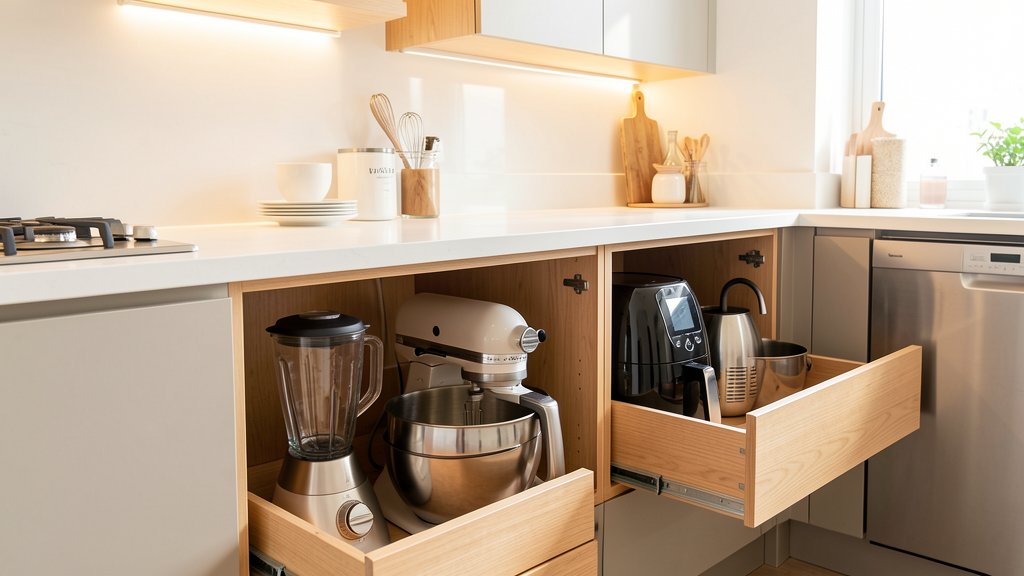
A pull-out shelf turns a deep cabinet into a series of accessible tiers. Instead of reaching in, you pull the shelf out on full-extension ball-bearing slides and everything in that cabinet is in front of you — including the part that used to not exist.
In a small kitchen specifically, three configurations do the most work:
- Tiered pull-outs in the deepest base cabinets. Two or three levels instead of one, so the back of the cabinet becomes a shelf you can actually reach.
- Blind-corner pull-outs. A narrow shelf built to the exact angle of the corner. The dead corner becomes usable spice or utensil storage without changing a single cabinet door.
- Under-sink pull-outs built around the plumbing. The shelf clears the pipe and swings out, so the messiest cabinet in the house has a system instead of a pile.
None of this requires new cabinets. Nothing about your boxes, doors, or faces changes. Most small-kitchen projects are measured, built, and installed in a couple of visits, and a typical run of eight to ten pull-outs starts around $999 installed.
Measure your cabinet before you measure anything else
If your kitchen is tight, you have something in your favor: you already know exactly which cabinets are failing you. Before anyone quotes you anything, open each one and note three numbers — interior width, depth to the back panel, and how the door swings when open.
Those numbers are the whole project. A custom pull-out is built to your cabinet’s actual dimensions, not to a spec sheet, so “close enough” never comes up. If the numbers don’t match any product you can buy off a store shelf, that’s not a shopping problem — it’s a measuring problem, and it’s exactly the kind of job a custom shop exists for.
What a small-kitchen project looks like in practice
The process is simple and it’s the same whether you have three problem cabinets or all of them:
- Free in-home measurement. We come out, open every cabinet, measure, and walk through what would work where. No obligation.
- Written quote before anything starts. The number you see is the number you pay.
- Build and install. Shelves are made in our Phoenix shop on hardwood with 100-lb capacity, full-extension ball-bearing slides, and installed — most projects in a single visit.
Every shelf carries a lifetime warranty. For a small kitchen where every drawer and every inch is doing double duty, that matters.
Start with the cabinet you use every day
You don’t need to solve the whole kitchen at once. Start with the one cabinet you open fifty times a day and hate — usually the base cabinet next to the stove or the one holding the everyday dishes. Fix that one, and the rest of the kitchen stops competing for the space it already had.
If your kitchen is small and the reach-in cabinets are winning, it’s time to make them work. See our kitchen pull-out shelf options, or request a free in-home consultation — we’ll come out, measure your cabinets, and tell you honestly what would help and what wouldn’t.
Shelf Theory · 3440 W Lewis Ave Suite G, Phoenix, AZ 85009 · (602) 799-9626 · shelftheory.com