


You have a budget. You have fifteen cabinet doors. Where do you start?
Here is the question we hear most often from homeowners across Phoenix and the West Valley: “I want custom pull-out shelves, but I am not going to do the whole kitchen.” And that is completely fine. Most of our projects are targeted upgrades — four, six, maybe eight cabinets — not full kitchen rebuilds. The catch is that picking the wrong cabinets first means paying for the upgrade where you feel the least benefit. The right first cabinet is the one you open ten times a day. The wrong one is the one you open twice a year.
This is the prioritization guide we wish every customer had before the phone call. It is the same ranking we use when we walk into a home during a free consultation, and it applies whether you are in a West Valley Craftsman, a Scottsdale mid-century modern, or a new build on the Las Vegas side of the desert. (Yes — we install in Las Vegas now, and the logic is identical.)
Start where you struggle, not where it looks worst
The instinct is to upgrade the cabinet that looks the most chaotic — the one with the falling-over containers and the mystery tupperware graveyard. But kitchen organization is a flow problem, not a looks problem. A cabinet can look messy but rarely be opened, and a cabinet can look fine and cost you two minutes of frustration every single morning.
Do a quick audit for one week: keep a tally of the cabinets you open most and the ones that make you bend, reach, or dig. That tally, not the aesthetics, should drive your first purchase.
The upgrade order we actually recommend
Priority one: the deep base cabinets under your counter
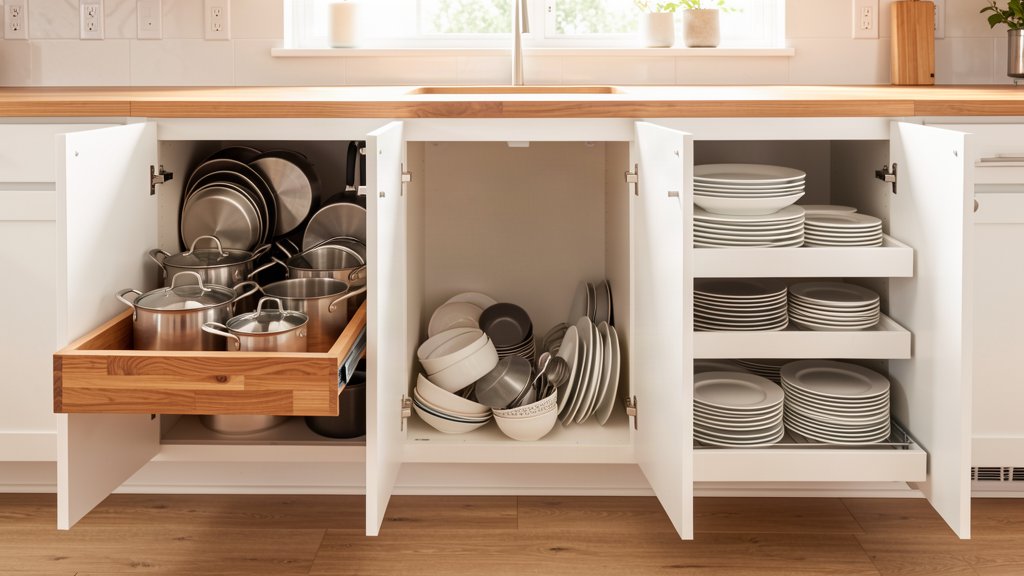
These are the big ones — the tall base cabinets below your countertop that hold the pots, the casserole dishes, the food storage you do not use every day. A standard 24-inch or 30-inch base cabinet is 24 inches deep and 34 inches or more tall. Without a pull-out, the back half of that cabinet is essentially a small storage closet you pay rent on forever. A custom pull-out shelf on full-extension ball-bearing slides brings the entire depth of the cabinet to you in one smooth motion. This single cabinet type delivers the most “wow, I did not know it worked like this” moment per dollar we can point to. If you upgrade exactly one cabinet in your kitchen, make it the deep base cabinet nearest your cooktop.
Priority two: the cabinet under your sink
The under-sink cabinet is the messiest space in the kitchen for a reason: pipes, an awkward box of a space, and a floor that catches every dropped item. A custom pull-out shelf built around the P-trap turns that space into a clean, fully visible shelf you can actually see when you open the door. It is one of the most requested upgrades we install across Phoenix, and the reason is simple — it stops the one cabinet where you always lose something.
Priority three: blind corners and the space behind doors
Corner cabinets and the narrow cabinet behind a door have always been the dead zones. A traditional lazy Susan solves half of the problem; a corner pull-out or a door-mounted shelf solves the whole one. These are fantastic second- and third-round upgrades because they reclaim space you had already given up on. They are rarely the highest daily-use cabinet, so they are not first — but they are where the value-per-cubic-inch of the entire project jumps.
Priority four: pantry and tall cabinet organization
Pantry organization with pull-out shelves earns its keep in any household that does weekly grocery runs. A tall pantry cabinet with two or three pull-out shelves means every jar is at eye level and every grab is a pull, not a reach. If your kitchen has a dedicated pantry — walk-in, tall cabinet, or butler — this is where the daily payoff compounds. If you have a small or narrow pantry, a 15-inch pull-out can make that cabinet behave like a walk-in.
What to skip for your first project
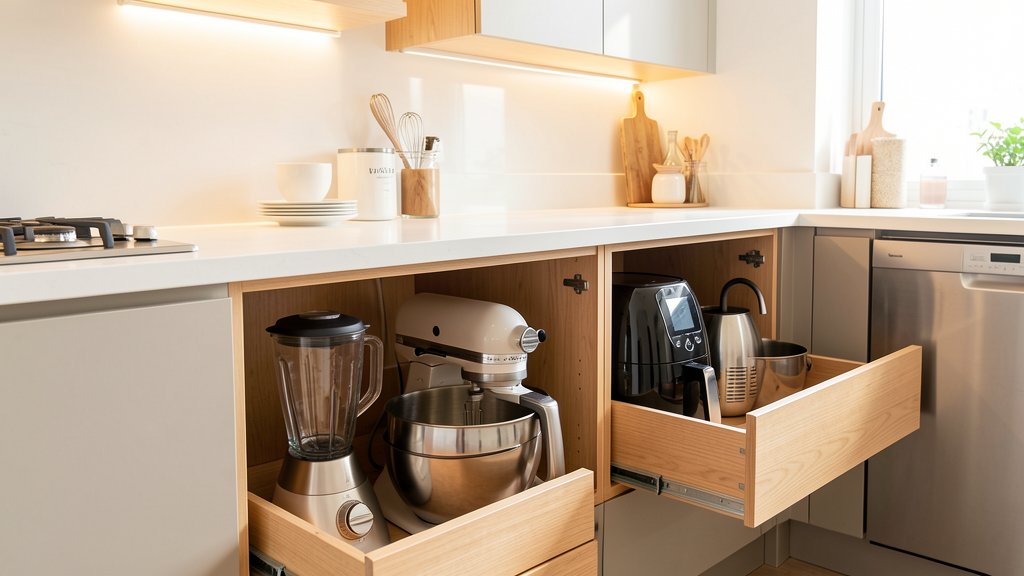
Not every cabinet earns the upgrade in year one. The upper cabinets you open once a season for holiday dishes are not there. A single small appliance garage is nice-to-have, not must-have. And if you are trying to hold the project to a budget, resist the temptation to spread thin across the whole kitchen — four excellent pull-outs in the cabinets you use daily will outperform eight mediocre ones scattered around. Depth of upgrade beats width of upgrade, every time.
A local angle: what Phoenix and Las Vegas kitchens actually need
Two things about our two service areas shape the typical project. First, Arizona sun. The heat that sits on a west-facing kitchen cabinet in Phoenix does things to cheaper, softer woods and to plastic organizers — which is exactly why we build from solid hardwood on ball-bearing slides rated for 100 pounds or more, and why so many local customers come to us after a run of store-bought organizers that warped or stripped in a year. Second, the new-build pipeline. If you just closed in a new build in the West Valley, Scottsdale, or over in Las Vegas, the cabinet layout was designed for a showroom photo, not for your grocery list. That is the perfect time to plan pull-outs in before the first big grocery trip, and it is the cheapest point at which to make them part of the home.
Get the list before you spend a dollar
The ranking above is the version we use on site, and it is the one we are happy to walk through with you cabinet by cabinet — including which of yours land in priority one and which can wait. The audit takes fifteen minutes, the estimate is free, and you can book it online or over the phone.
Contact Shelf Theory today for a free consultation and walk away with a ranked list of exactly which cabinets to upgrade first — and why.