


Not Every Phoenix Kitchen Comes With a Walk-In Pantry
Walk-in pantries get all the attention because they are easy to picture: floor-to-ceiling shelving, labeled jars, that satisfying moment when everything has a home. But most kitchens in the Valley do not have a walk-in. They have a standard-width pantry cabinet — sometimes just a broom closet with a shelf and a stack of items nobody remembers putting there.
The good news: you do not need a walk-in to get the organized-pantry feeling. The same storage principle that makes a walk-in work — everything visible, everything within reach — works in a 15- to 30-inch cabinet too, if the shelving can pull out.
The Problem With Fixed Pantry Shelves
Fixed shelves create the classic pantry trap: the front half is usable, and everything else is a maze. Flour sits behind the flour. You buy a second box of pasta because the first one is wedged behind the cereal on the back shelf.
And it is not just visibility. Even when you can see the back of the shelf, reaching it means stepping back, craning, or holding the front items in one arm. A small pantry already has little floor footprint, so wasting the back half of each shelf costs you real usable storage.
How Pull-Out Pantry Shelves Change the Space
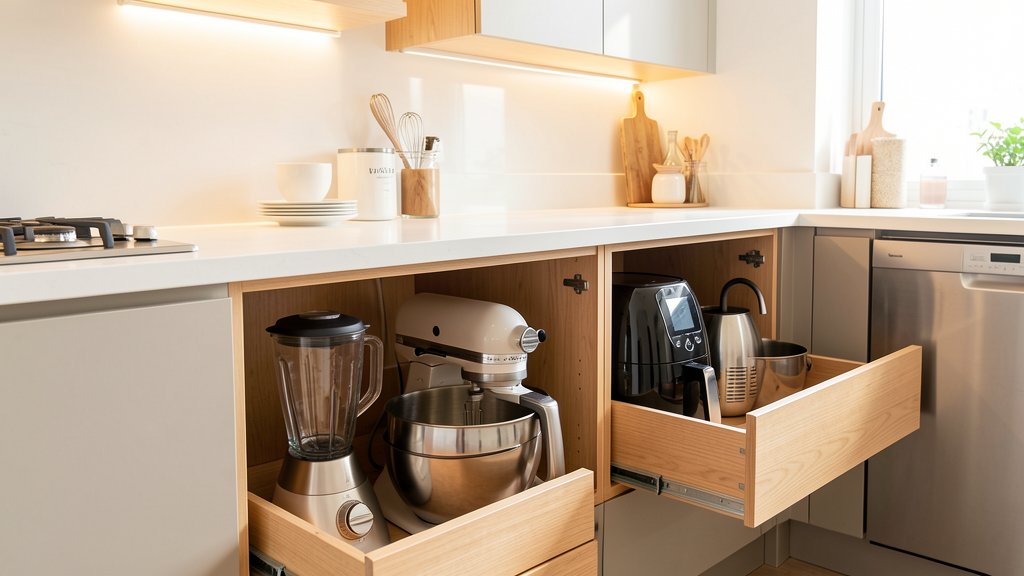
A pull-out pantry shelf turns the cabinet into a moving shelf. When you pull it out, the back wall of the cabinet comes out with it — so the spot that used to be the hardest to reach becomes the closest thing to you. The full depth of the cabinet becomes one continuous, reachable surface.
For a small pantry, that matters more than it does in a walk-in, because you have less vertical room to work with. Typical setups we install in narrow pantry cabinets include:
- Two to four pull-out levels sized to the cabinet’s interior width, so no shelf is too wide to slide or too narrow to be useful
- Full-extension ball-bearing slides rated for 100+ lb, so a shelf loaded with canned goods still glides out smoothly and stays where you park it
- Dividers or tiered sections on select levels to stop jars and boxes from rolling around when the shelf moves
Because the shelving is built to the exact interior dimensions of your cabinet, there is nothing to shim, force, or cut. The doors stay, the cabinet frame stays, and the hardware fits inside.
Fitting It Into a Small or Odd Pantry
Small pantries often have quirks that make off-the-shelf organizers a bad fit:
- Narrow width. A 15-inch cabinet is too narrow for most store-bought pull-outs. Slim pull-out shelves with appropriately sized rails handle it fine.
- Obstructions. Water lines, pipes, or wall studs can limit shelf depth in a closet pantry. We measure around them so the shelf stops short of the obstruction without leaving a gap you cannot reach.
- Short height. A low pantry cabinet under a counter or window works best with just one or two pull-out levels plus a fixed shelf on top for the items you reach daily.
If your “pantry” is a single tall cabinet with fixed doors, it can usually take two side-by-side pull-out sections — which doubles the usable surface and makes loading groceries dramatically faster.
What To Store Where (A Small Pantry Layout That Works)
Once the shelves pull out, the organizing part becomes obvious, but a few placement habits make a small pantry run itself:
- Bottom levels carry the heavy stuff. Canned goods, pasta boxes, and the big flour bag belong on the lowest pull-outs. The slides handle the weight; your back is grateful.
- Eye level is your daily-use row. The items you reach for two or more times a week — oil, the pasta you actually cook, the cereal the kids eat — go on the middle shelves, front-of-cabinet, where you grab them without a search.
- Top level is the overflow shelf. Seasonal items, baking supplies, and the backup stock that sits for months belong up high, out of the way but still visible when the shelf comes out.
- Uniform containers are optional, consistency is not. Matching glass jars look great, but the real win is that everything is the same size — which is what makes a small space stop feeling chaotic.
If you have a very narrow pantry, consider one pull-out level plus a fixed shelf: the pull-out handles the mid-height daily items, and the fixed top shelf takes the light, infrequently used stock.
The Payoff: A Pantry You Actually Use
The point of organizing a small pantry is not aesthetics — it is that you stop buying duplicates, stop hunting for things, and stop the back of the shelf becoming a place where food goes to expire. When the whole shelf comes out to you, every level works the same as the front row.
For most small-pantry projects, the install is a single visit. You keep using your kitchen the same day, with nothing demo’d and no new cabinets required. It is one of the highest-leverage small investments you can make in a kitchen that has been living with a tight pantry since the house was built.
See What a Custom Pantry Setup Looks Like in Your Cabinet
Every cabinet is different, and the difference between a shelf that works and one that jams is the measurement. We offer free in-home design consultations across the Phoenix metro — we measure your pantry, show you the options, and give you a written quote before any work starts.
Explore what we can build for your space on our pull-out shelves page, or schedule your free consultation today. Call (602) 799-9626 to get started.