
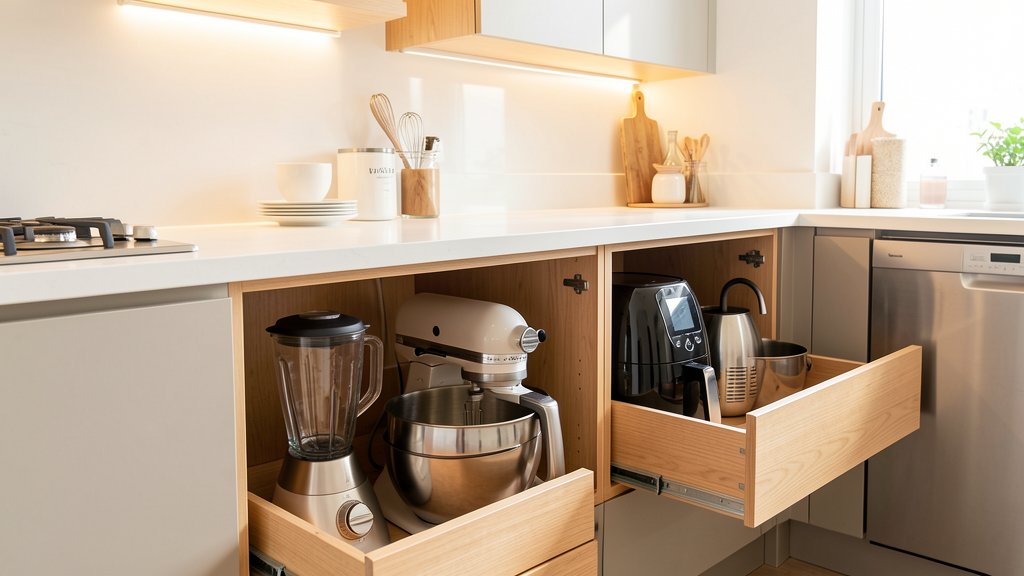


If you’ve ever crouched on the kitchen floor, head halfway inside a base cabinet, blindly fishing around for a pan you’re pretty sure is buried somewhere in the back, you already understand the problem. Standard cabinets look fine on the outside. Inside, they’re a black hole where storage potential goes to die.
Pull out cabinets fix that. And once you have them, it’s very hard to go back.
What Are Pull Out Cabinets?
Pull out cabinets are base or pantry cabinets fitted with shelves, drawers, or trays that slide out on a track system. Instead of a fixed shelf you have to reach over and around, the storage comes to you. You open the door, pull the shelf forward, and everything inside is right in front of you at a glance.
The mechanism is simple: a set of drawer slides (usually full-extension or soft-close ball-bearing slides) is mounted to the interior walls of the cabinet frame. The shelf or tray sits on those slides and glides in and out smoothly. Some systems pull out as a single shelf; others are stacked two or three levels deep, each on its own set of slides.
You’ll find pull out shelves in a few common configurations:
Single pull out shelves replace a fixed shelf in a standard base cabinet. They work well for pots, pans, and pantry goods where you just want better access to what’s already there.
Double-tier pull outs stack two shelves inside one cabinet, effectively doubling your usable storage. The lower shelf slides out, and so does the upper one, independently.
Pull out drawers in base cabinets are similar in concept to a deep drawer but function as a full cabinet interior that rolls forward. These are popular for storing mixing bowls, small appliances, and cleaning supplies.
Pantry pull outs are tall, narrow shelving units built into pantry cabinets. They’re ideal for canned goods, spices, and dry pantry items where visibility matters as much as space.
Specialty pull outs include lazy-susan style corner solutions, pull out trash and recycling bins, tray dividers, and drawer inserts for pots and lids. These serve specific organizational purposes rather than general storage.
Why Pull Out Cabinets Beat Standard Fixed Shelves
The honest answer is visibility and access. Those two things are responsible for almost every frustration people have with kitchen storage.
You Can Actually See What You Have
With a fixed shelf, anything stored beyond arm’s reach becomes invisible in practice. You know it’s there, but you don’t reach for it because you’d have to dig. So you buy duplicates. You forget about things. Pantry items expire because they migrated to the back two years ago and haven’t been touched since.
A pull out shelf brings the back of the cabinet forward. Everything you own is visible at once. That single change has a real effect on how you shop, cook, and use your kitchen.
Access Without the Acrobatics
Bending, kneeling, twisting, and reaching are all part of life with standard base cabinets. For people with back pain, knee problems, or limited mobility, this isn’t just inconvenient. It’s a genuine barrier to using their own kitchen comfortably.
Pull out shelves eliminate most of that. You open a door, pull the shelf toward you, and everything is at counter height or just below. No contorting required.
Better Use of Existing Space
Fixed shelves, particularly in deep base cabinets, have a zone in the back that almost never gets used. You can’t reach it easily, so you don’t. That square footage is wasted.
Pull out shelves use the full depth of the cabinet because when you slide the shelf out, the back becomes the front. A 24-inch deep cabinet becomes a 24-inch deep pull out, rather than a 14-inch deep functional space with 10 inches of dead storage behind it.
Less Clutter and Stacking
Without easy access, people tend to stack things on top of each other rather than placing items in logical groups. The frying pan goes on top of the saucepan because that’s the easiest way to get to either of them. The result is unstable, noisy, and occasionally dangerous.
Pull out shelves make it practical to actually organize by category. Pans on one shelf. Lids on another. Baking sheets in a vertical tray. Because you can pull each shelf out independently, stacking becomes unnecessary.
They Hold More Than You Think
The load capacity of quality pull out slides is substantial. Most residential pull out shelves are rated for 75 to 100 pounds. That’s more than enough for a full set of cast iron cookware or a pantry shelf loaded with canned goods.
Can Existing Cabinets Be Converted?
Yes, and this is where things get practical for most homeowners. You do not need to replace your cabinets to get pull out shelves. In the majority of cases, existing cabinetry can be retrofitted without any major work.
What the Retrofit Process Looks Like
Retrofit pull out kits are widely available and designed to install inside standard cabinet openings. The process generally involves measuring the interior width of your cabinet, selecting a shelf that fits with some clearance on each side, and mounting the slides to the cabinet walls.
For most people with basic DIY confidence, this is a weekend project. You need a drill, a level, a measuring tape, and the kit itself. Cabinet interiors don’t usually require cutting, painting, or patching.
Professional installation is also available through kitchen remodelers and cabinet companies, including Shelf Theory, if you’d rather have it done correctly the first time and not spend a Saturday on it.
What to Measure Before You Buy
The two measurements that matter most are the interior width and the interior depth of your cabinet. Width determines the size of pull out shelf you can fit. Depth determines how far the shelf can extend and how much of the cabinet’s storage you’ll actually access.
Also check the door opening. Some cabinets with center stiles (the vertical divider between two doors) have a narrower opening than the interior suggests. A shelf that fits inside may not slide out past the stile. Face frame cabinets and frameless cabinets behave differently here, so knowing your cabinet type before purchasing matters.
What About Corner Cabinets?
Corner cabinets are the worst offenders for wasted space, and they’re also the hardest to retrofit. Standard pull out slides don’t work in a corner configuration because the geometry doesn’t allow a straight pull forward.
The most common solutions for corners are blind corner pull outs, which use an L-shaped or swing-out mechanism to bring items to the front, and full corner lazy susans mounted on a pull out frame. These do require more precise measuring and usually more involved installation, but they transform what is often the least usable space in the kitchen into genuinely functional storage.
When Retrofitting Won’t Work
Not every cabinet is a good candidate. Very old cabinets with warped or unstable frames may not mount slides securely. Cabinets with structural damage or pest problems should be addressed before any retrofit. Very shallow cabinets (under 12 inches deep) often aren’t worth converting because the pull out gain is minimal.
If your cabinets are in good structural condition, though, retrofitting is almost always the more cost-effective path compared to full replacement.
Choosing the Right Pull Out for Your Needs
Not every pull out shelf is the same, and getting the right one depends on what you’re storing.
For pots and pans: Deep, sturdy single-shelf pull outs with high load ratings. Look for full-extension slides so the back of the cabinet is fully accessible.
For pantry items: Two-tier or three-tier pull outs with shorter shelf heights work well for cans, jars, and boxes. You want to maximize vertical space while keeping items visible.
For under the sink: Pull outs designed to work around plumbing are available with cutouts or adjustable frames. This area is often left completely disorganized because it’s awkward to retrofit. A purpose-built under-sink pull out makes a noticeable difference.
For spices: Narrow pull out towers or tiered spice inserts keep small items from getting buried. These work particularly well in pantry cabinets or the dead space next to a refrigerator.
For recycling and trash: Pull out bins have become standard in well-designed kitchens. Keeping bins inside a cabinet keeps the kitchen cleaner and reduces odor spread.
The Practical Case for Pull Outs
Pull out cabinets aren’t a luxury item. They’re a functional improvement to a space that most people use multiple times a day, every day. The time saved not hunting for things, the frustration avoided, the food that doesn’t get forgotten and wasted, these things add up quickly.
Whether you’re planning a full kitchen renovation or looking for a targeted upgrade to a few problem cabinets, pull out shelves offer one of the better returns for the investment. They work with what you have, they last for years with minimal maintenance, and they make the kitchen noticeably easier to use from day one.
If you’re starting with your worst cabinet, the one you dread opening, that’s usually the right place to begin.